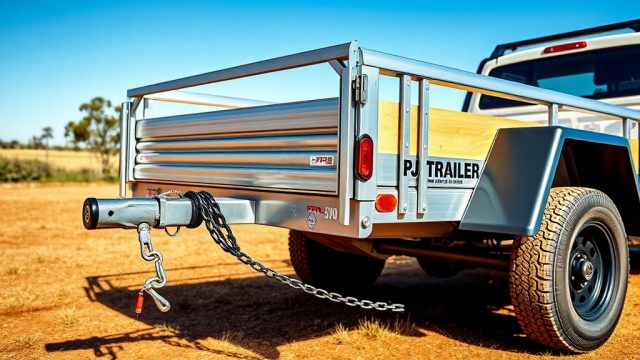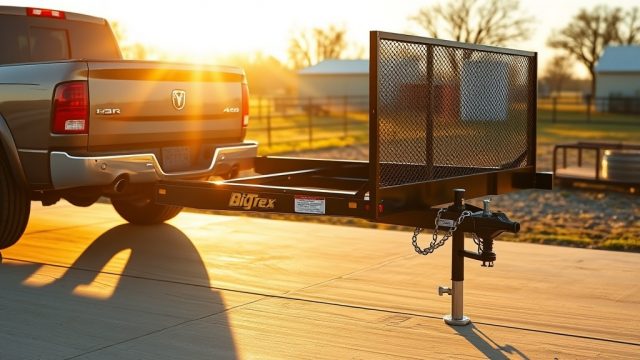
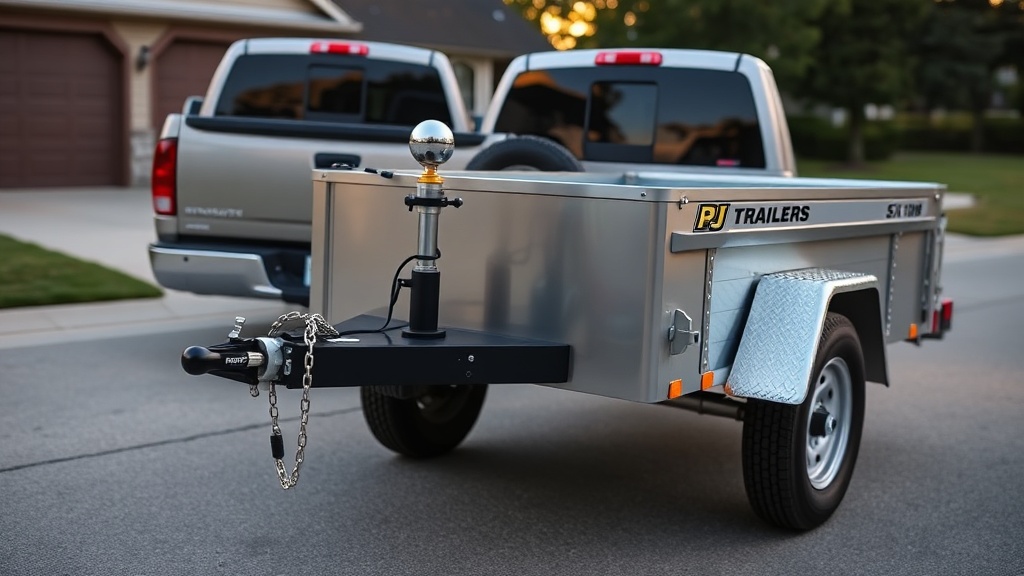
Properly setting up the towing hitch on a PJ Trailers 5×10 is critical for safe transport and equipment longevity. Even the best-built utility trailer cannot perform reliably if the ball mount, coupler, and wiring are not matched to the vehicle’s capacity and the load. This step-by-step guide walks through every stage of the hitch installation process, from selecting the correct ball size to confirming a secure electrical connection.
What Size Ball Coupler Does a PJ Trailers 5×10 Require?
The standard coupler on most PJ Trailers 5×10 models is a 2-inch ball coupler. This design is compatible with Class III and Class IV hitches commonly found on half-ton trucks, SUVs, and full-size vans. It is essential to verify the coupler’s diameter by measuring the inner diameter of the coupler socket (2 inches) and the ball itself. Using a mismatched ball—such as a 1-7/8-inch ball in a 2-inch coupler—creates dangerous slack and can cause the trailer to detach during transit.
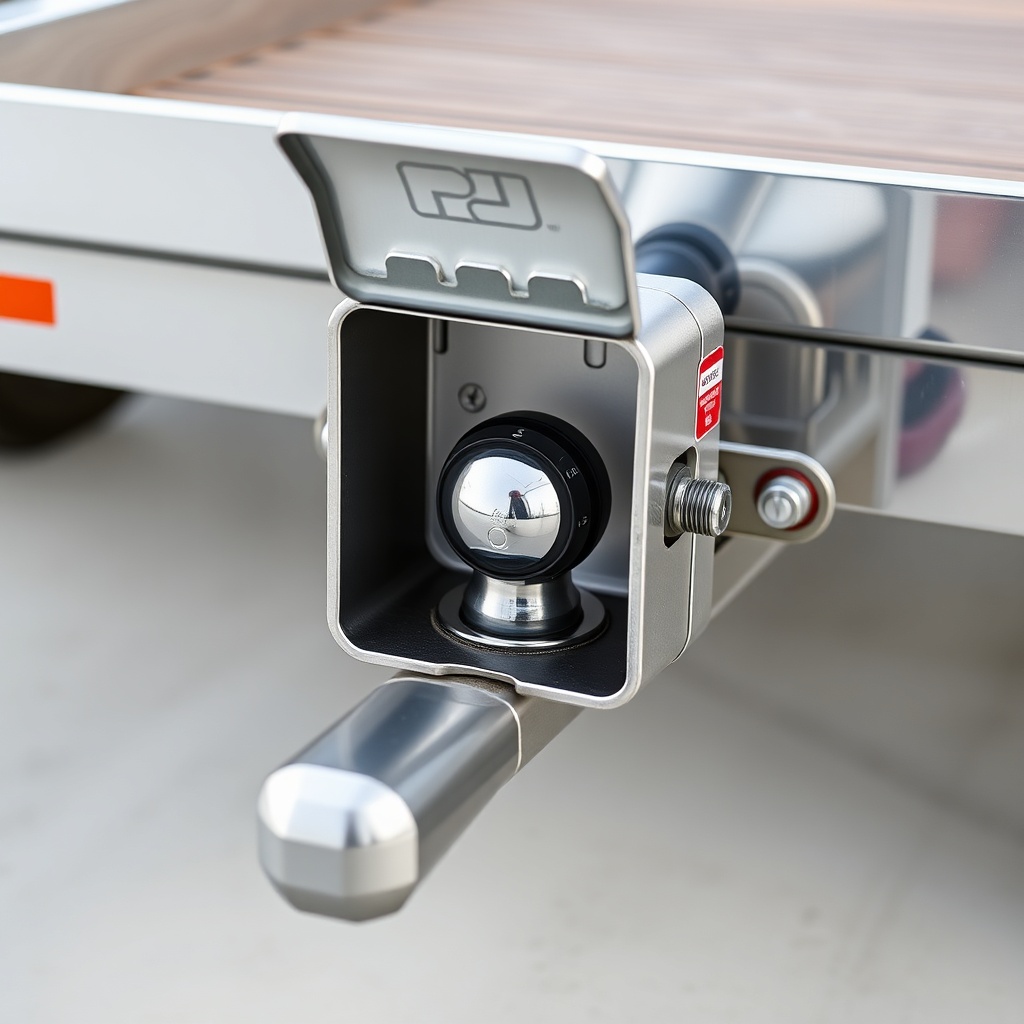
Which Weight Rating Should the Hitch Be Rated For?
A PJ Trailers 5×10 typically has a gross vehicle weight rating (GVWR) of 2,990 to 3,500 pounds, depending on the specific configuration and optional upgrades. The towing hitch must have a minimum weight capacity equal to or greater than the trailer’s GVWR plus any additional payload. For most standard models, a Class III hitch (rated to 5,000 pounds gross trailer weight and 500 pounds tongue weight) is sufficient, but a Class IV hitch (rating up to 10,000 pounds) offers a safety margin. The table below summarizes common hitch classes and their relevance to the PJ Trailers 5×10:
| Hitch Class | Gross Trailer Weight Capacity | Tongue Weight Capacity | Recommended for PJ 5×10? |
|---|---|---|---|
| Class I | 2,000 lbs | 200 lbs | No—undersized |
| Class II | 3,500 lbs | 350 lbs | Marginal—check specific GVWR |
| Class III | 5,000 lbs | 500 lbs | Yes—sufficient for standard model |
| Class IV | 10,000 lbs | 1,000 lbs | Yes—exceeds requirements |
What Is the Correct Tongue Weight for a PJ Trailers 5×10?
Tongue weight should be 10% to 15% of the loaded trailer’s gross weight. For a PJ Trailers 5×10 carrying 2,500 pounds of cargo (total weight around 3,500 pounds), that translates to 350 to 525 pounds of tongue weight. Exceeding 525 pounds can overload the hitch, while too little tongue weight (under 350 pounds) may cause dangerous sway at highway speeds. Use a tongue weight scale to verify the measurement after loading. For detailed loading techniques, see the PJ Trailers 5×10 Weight Capacity and Loading Tips for Safe Towing guide.
How to Wire the Trailer Lights and Brake Controller
The PJ Trailers 5×10 comes with a standard 4-flat wiring harness for tail lights, brake lights, and turn signals. If the trailer is equipped with surge brakes or electric brakes, a 7-pin round connector is necessary. Follow these steps for a reliable electrical setup:
- Verify the vehicle has a compatible wiring harness—most trucks have a 4-pin or 7-pin socket.
- Use a multimeter to test that the vehicle’s wiring provides proper voltage (12V) for the trailer lights.
- For electric brakes, install a brake controller in the vehicle’s cab and set the gain according to the trailer weight.
- Secure all connections with dielectric grease to prevent corrosion.
- Test all lights (running, brake, turn signals) before driving.
Rust prevention on electrical components is discussed in the How to Maintain and Rust-Proof Your PJ Trailers 5×10 article.
How to Attach the Safety Chains Correctly
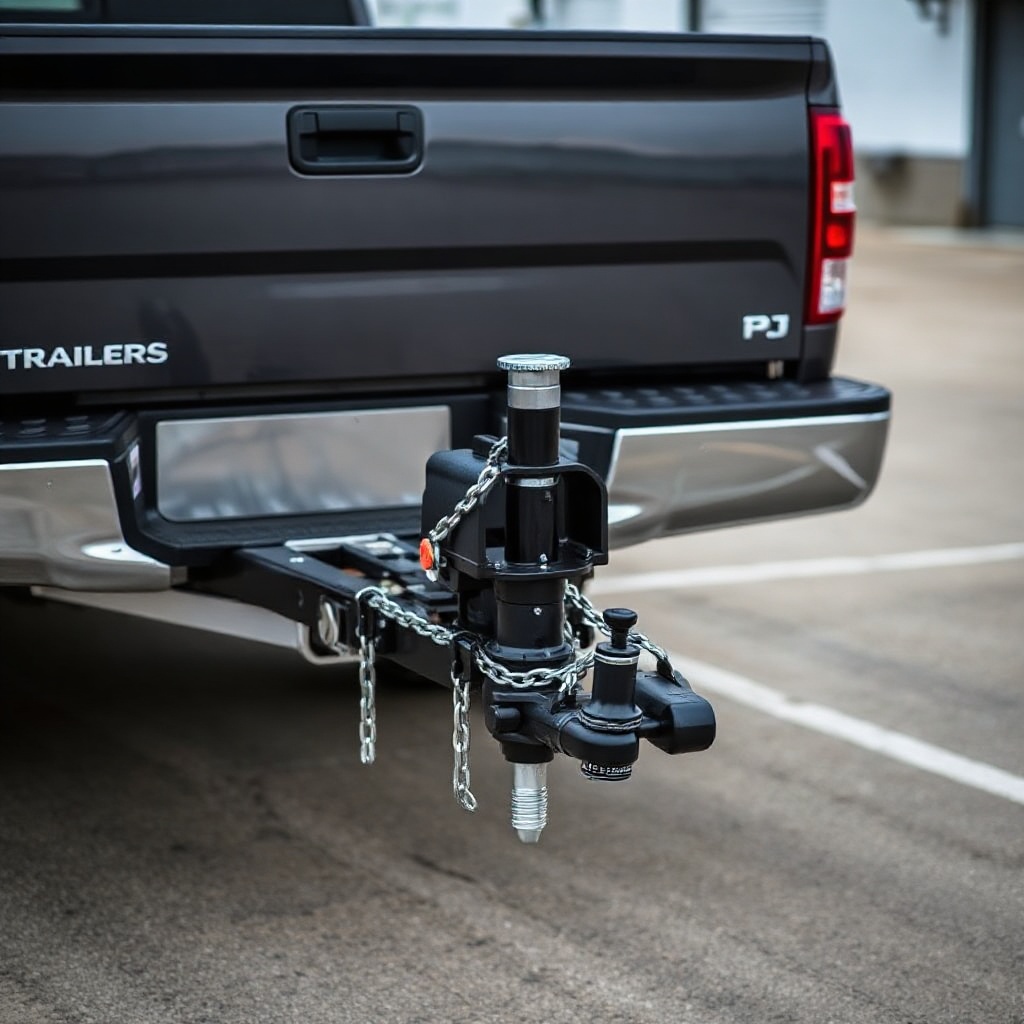
Safety chains are a legal requirement in most jurisdictions and must be crossed under the trailer tongue to create a cradle that catches the tongue if the coupler fails. For a PJ Trailers 5×10, use two chains with hooks that match the vehicle’s chain loops. The chains should have enough slack to allow turning without straining, but not so much that they drag on the road. The recommended chain length is such that the hooks attach at the same height as the ball mount to prevent binding. Always double-check that the chain hooks are closed and can’t slip off during travel. Proper chain selection is also covered in the PJ Trailers 5×10 Towing Hitch Setup Guide.
What Owners Say About Hitch Setup
Many owners of the PJ Trailers 5×10 praise its rugged build and ease of coupling, but they also emphasize the importance of correctly torquing the ball mount bolts. Several on forums report that using a torque wrench to 120 foot-pounds on the 5/8-inch diameter bolt prevents loosening on rough roads. Others note that the coupler latch can be stiff when new and recommend lubricating it with a dry-film lubricant after the first use. One common mistake owners mention is forgetting to raise the trailer jack before connecting the safety chains, which can cause the tongue weight to shift unexpectedly. For ramp-specific concerns, the PJ Trailers 5×10 Ramp Options and Loading Tips offers additional insights.
Frequently Asked Questions
1. Can I use a 1-7/8-inch ball on a PJ Trailers 5×10?
No. The standard coupler is designed for a 2-inch ball. Using a smaller ball creates excess play and can lead to detachment.
2. What is the maximum tongue weight for a PJ Trailers 5×10?
The manufacturer recommends a tongue weight between 10% and 15% of the gross trailer weight. For a 3,500-pound GVWR, that is 350 to 525 pounds.
3. Do I need a brake controller for a PJ Trailers 5×10?
If the trailer is equipped with electric brakes (common on heavier models), a brake controller is required. For trailers under 3,000 pounds without brakes, no controller is necessary, but it is still recommended for stability.
4. How often should I check the hitch bolts?
Every 500 miles or before each long trip, check that the ball mount bolts are torqued to specification and that the coupler latch operates smoothly.
5. Can I tow a PJ Trailers 5×10 with a passenger car?
Only if the passenger car has a properly rated hitch and towing capacity. Most compact cars lack the capacity for a 3,500-pound trailer; a half-ton truck or SUV is preferred.
6. What is the best way to prevent rust on the hitch components?
Regularly clean the ball mount and coupler with a wire brush, apply a coat of rust-inhibiting paint or spray, and store the trailer with the coupler covered. See the PJ Trailers 5×10 Maintenance and Rust Prevention Guide for detailed steps.
For a broader comparison of trailer options, see the PJ Trailers 5×10 vs Wells Cargo 6×12: Which Is Better? article.