Wells Cargo 6×12 Utility Trailer: What to Know Before Buying
For those needing a rugged, dependable utility trailer for hauls ranging from landscaping equipment to small vehicles, the Wells Cargo 6×12 stands out as a solid choice from a respected American manufacturer. But before you commit, it’s essential to understand the key specs, common pitfalls, and real-world performance. This buying guide cuts through the marketing to help you decide if this trailer fits your specific needs and budget.
What Is the Actual Payload Capacity of the Wells Cargo 6×12?
The payload capacity of the Wells Cargo 6×12 varies by model and configuration, but a typical example—such as the classic SC (Standard Cargo) series with wood floor and 15-inch wheels—offers a GVWR of around 3,000 lbs. Tare weight (empty trailer) hovers near 1,300 lbs, leaving you with roughly 1,700 lbs of usable payload. However, if you opt for the heavier-duty HD (Heavy Duty) model with steel floor or a ramp gate, the tare weight climbs to about 1,500 lbs, cutting payload to about 1,500 lbs. Always check your specific VIN plate; the manufacturer’s certified GVWR is the only acceptable number. For towing stability, keep your tongue weight around 10–15% of the loaded weight—never exceed 400 lbs on the 2-inch ball coupler.
Payload is further affected by accessories like spare tire mounts, side vents, or interior lighting. Realistically, if you’re hauling something like a small tractor (approx 1,200 lbs) plus tools and fuel, you’ll be near the limit. Consider upgrading to the 5,000 lb GVWR axle option for heavier loads, which bumps payload to about 3,500 lbs. For a detailed breakdown of weight distribution and how to avoid axle overloading, read our Wells Cargo 6×12 Payload and Weight Distribution Guide.
How Does the 6×12 Compare to Competitors Like Haulmark or Big Tex?
In the 6×12 segment, Wells Cargo faces strong competition. The key differentiators are build quality and price. While Big Tex often offers a lower entry price (around $2,800–$3,500 new), owners report that Wells Cargo’s steel frame and thicker gauge aluminum (typically .030-inch for roof and .040-inch for sides) withstand road salt and rust better over the long term. Haulmark trailers in this size range (e.g., the “Haulmark Edge”) weigh slightly less—around 1,100 lbs tare—but use lighter-duty frames that can flex under heavy loads.
| Issue | Severity |
|---|---|
| Loose or corroded trailer wiring causing intermittent lights | Usually not urgent (check monthly) |
| Worn or under-inflated tires (especially 14-inch models) | Needs attention soon (inspect before each trip) |
| Spring hanger bolts working loose | Needs attention soon (torque to spec) |
| Door seal gaps letting in moisture | Usually not urgent (seal with weatherstripping when convenient) |
Wells Cargo also uses a better paint process—electrostatic application plus oven curing—that holds up better than the powder coating on some cheaper brands. However, this means a higher new price: expect to pay $3,800–$5,200 for a base 6×12 SC model in 2024–2025, depending on dealer markup and features. If your budget is tight, consider a used Wells Cargo from the 2018–2020 range, which can be found for $2,000–$3,000 in decent condition.
Which Floor Material Is Best for Your Trailer: Wood, Steel, or Aluminum?
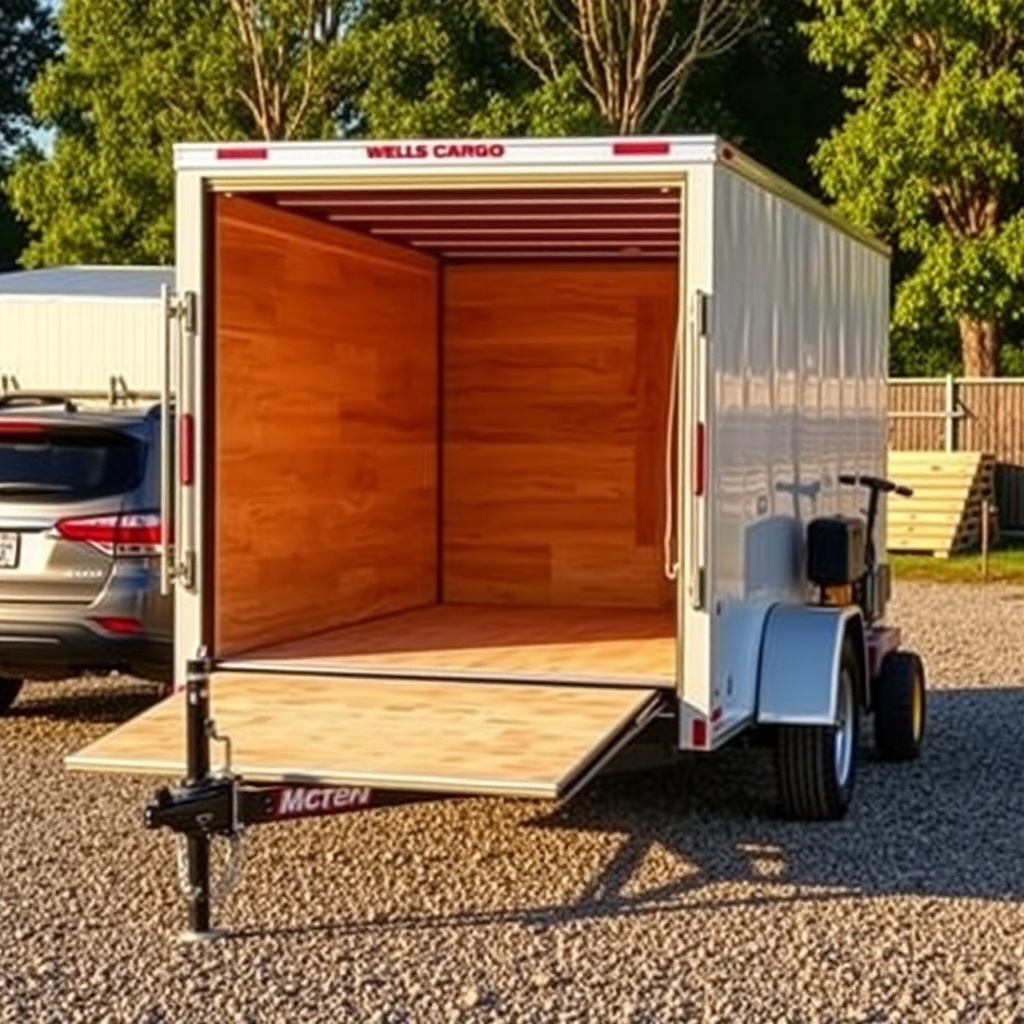
Wells Cargo offers three floor options on the 6×12, each with trade-offs in durability, cost, and maintenance. Wood floors (standard on SC models) are pressure-treated 5/8-inch plywood laid over galvanized straps. They’re lightweight and affordable, but they rot over time, especially if the trailer sits outside without a cover. Owners frequently replace wood floors after 5–7 years. Steel floors (common on HD models) are diamond-plate, 14-gauge steel—extremely durable for equipment like ATVs and mowers, but they add about 200 lbs and can rust if scratched. Aluminum floors (premium option) weigh less than steel and resist rust, but they dent more easily and cost $300–500 extra. For most utility uses, steel is the best value if you expect heavy loads; wood is fine for light cargo like furniture or camping gear.
Whichever you choose, ensure the floor is properly sealed at edges and around tie-down rings to prevent water intrusion into the frame. Use a clear silicone sealant annually. If you tow in snowy or salty environments, consider having the undercarriage fluid-film coated to protect the crossmembers.
How Reliable Is the Wiring and Lighting System on Older Models?
Wells Cargo trailers from the late 2000s and early 2010s have a reputation for wiring issues, particularly corrosion at the junction box under the trailer and at the taillight housings. The factory uses a 7-pin round plug (common for commercial use) and a five-wire harness. Over time, the rubber grommets can crack, allowing moisture into the connectors. Symptoms include intermittent marker lights, weak brake signals, or complete lighting failure. Checking and cleaning the harness connections with dielectric grease every six months is crucial. If you encounter flickering or dim LEDs after driving through rain, inspect the ground wire near the coupler—it’s a common failure point. For a step-by-step troubleshooting process, see our Wells Cargo 6×12 Lighting and Wiring Troubleshooting guide.
Newer models (2018 and after) improved wiring with sealed LED taillights and a water-resistant junction box, but the long tail wiring to the 7-pin plug still uses cheap corrugated conduit. Replace it with split-loom tubing for better protection if you notice chafing. Also, consider installing a breakaway switch if your trailer didn’t come with one standard—Wells Cargo often omits it on basic models.
What Are the Must-Have Accessories for the 6×12?
When buying a Wells Cargo 6×12, several accessories can significantly enhance usability. The most important is a side ramp door (around $250–400 option), which allows loading from the side without having to back up straight. This is invaluable for loading motorcycles or wheeled equipment in tight spaces. A spare tire mount (usually $75–150) is essential—carry a 14-inch or 15-inch match to your trailer tires. Many used trailers lack a spare. Side wall tie-down rings (E-track or D-rings) are worth adding (around $100 for a set of 4) to secure loads from shifting. Don’t forget wheel chocks and a tongue jack locking pin for security.
For lighting upgrades, consider adding interior LED strips with a switch (about $30–50) for loading at night. A stone guard in front of the trailer—often a piece of rubber or plastic—protects the lower front panel from gravel spray. If you plan to store the trailer outdoors, a custom-fit cover ($150–300) will extend the life of the roof and side panels by years. Finally, always purchase a breakaway battery kit (around $60) if not included; local laws in many US states require it for trailers over 1,500 lbs loaded.
How Does the 6×12 Perform for Towing With a Half-Ton Truck?
The Wells Cargo 6×12 is well-suited for half-ton pickups like Ford F-150, Chevrolet Silverado 1500, or RAM 1500. Loaded to maximum GVWR (say 3,000 lbs), the trailering weight is manageable—most half-tons can tow 7,000–10,000 lbs, so you’re well within limits. Tongue weight of about 350 lbs is comfortable. The 6×12 has a 6’6″ interior height, which provides decent headroom for standing while loading but catches wind slightly more than a flatbed. At highway speeds (65–70 mph), you’ll notice some sway if the load is unbalanced; a weight-distributing hitch is not required but helps stability, especially with a wind-prone tall load like furniture or stacked lumber.
Owners towing with SUVs or unibody vehicles (e.g., Honda Pilot) should check their vehicle’s maximum towing capacity for a trailer with brakes. Wells Cargo offers a brake option (usually surge or electric) on the 6×12, which is highly recommended for any load over 1,500 lbs. Without brakes, stopping distances increase significantly, especially on grades. The trailer’s 1.5-inch tongue box section is sturdy but not indestructible—avoid using it as a step.
What Owners Say
After scouring forums and owner reviews from sources like Trailer Life and Wells Cargo owner groups, three themes stand out. First, the build quality is consistently praised: “I’ve had my 2006 6×12 sitting outside since new, and aside from floor rot, the frame and skin look great after 18 years.” Second, the floor is the most common complaint: “The plywood floor in my 2015 SC rotted around the D-rings after four Utah winters; I replaced it with aluminum.” Third, the wiring on mid-2010s models is a known weakness: “I had to replace the whole harness after a corrosion issue; a simple dielectric grease application would have saved me $70.”
Overall, owners recommend the Wells Cargo 6×12 for those willing to do minimal preventive maintenance—especially sealing the floor seams and cleaning wiring connectors annually. It’s not a cheap trailer, but many find it lasts 15+ years with care.

Frequently Asked Questions
Is the Wells Cargo 6×12 suitable for hauling an ATV?
Yes, it’s ideal for a single ATV (usually 600–800 lbs) plus gear. Ensure you distribute weight forward to maintain tongue weight. A 2-inch ball coupler is standard; confirm your trailer has at least a 2,000 lb capacity rating.
What is the typical price range for a used Wells Cargo 6×12?
Depending on age, condition, and features, used models (2015–2023) range from $2,000 to $4,500. Check for floor rot and wiring condition before buying.
Can I tow the Wells Cargo 6×12 with a minivan?
Only if the minivan is rated for towing up to 3,000 lbs (e.g., Toyota Sienna, Chrysler Pacifica). Always verify your vehicle’s towing capacity and consider adding electric brakes for safety.
How do I maintain the wood floor on my Wells Cargo 6×12?
Seal the floor edges with silicone annually. Avoid leaving standing water inside. Replace the plywood after 5–7 years if it becomes soft. Consider a steel floor if you’ll haul heavy equipment often.
Does Wells Cargo still manufacture the 6×12 model?
Yes, the 6×12 SC and HD models are in current production. Contact a local dealer for custom orders or check their online inventory.
What size wheels and tires come on the 6×12?
Standard are 14-inch (ST185/80R13) on SC models, and 15-inch (ST205/75R15) on HD models. Upgrade to 15-inch for better ground clearance and longer tire life. Tires should be replaced every 5 years regardless of tread wear due to sidewall aging.